
What Crawford County Deeds Put on Record
Every Crawford County deed record begins with the instrument itself. It names the parties and gives the recording date. The deed also describes the land and states what interest was conveyed. The combined Clerk/Register of Deeds records far more than deeds, though. Mortgages, land contracts, liens, easements, assignments, discharges, affidavits, restrictions, and mineral-rights documents all pass through the same office. Each of these lands in the deed records. Those related filings help explain a property's history. Only some of them actually transfer ownership, so read each one for what it does.
| Deed Type | What It Does | Common Use |
|---|---|---|
| Warranty deed | Conveys the stated interest with deed warranties | Ordinary arms-length conveyance |
| Quitclaim deed | Conveys whatever interest the grantor holds | Family transfer or title correction |
| Trustee or representative deed | Conveys under trust or estate authority | Trust and probate administration |
| Corrective deed | Corrects a prior recorded instrument | Name or description repair |
| Sheriff or tax-related deed | Records a transfer tied to a statutory process | Foreclosure or delinquent tax proceeding |
A mortgage or a lien burdens an interest rather than conveying it. That distinction matters. Read assignments, releases, and discharges alongside the deed itself, so an old filing is never mistaken for a claim still active against the parcel.
Crawford County's Combined Deed Office
The Crawford County Clerk/Register of Deeds sits at 200 W Michigan Avenue in Grayling. Hours run Monday through Friday, 8:30 a.m. to 4:30 p.m. The office closes from noon to 1 p.m. Call 989-348-2841. Occasional users can search through the Register's Tapestry link. Professionals can arrange Laredo access. Walk-in visitors can use public computers at the counter.
Phone or written requests work best with full details. Include the instrument type, both party names, and an approximate recording date. Add the parcel number or legal description. Note whether a certified copy is needed. Staff will retrieve deed records for requesters. They cannot give legal advice or prepare a deed.
The office's own process explains why the recorded image counts most. Crawford stamps each transaction into a liber. That image becomes the permanent county record. The Register does not retain the signed original. So keep two things distinct in any search packet. One is the paper the parties signed. The other is the county's recorded image with its index citation. When an online result shows only a short row, ask a question. Can the full image be opened on a public computer? Can it be pulled by staff? Note any redaction, missing page, attachment, or cross-referenced document before treating the copy as complete.
The official Register page displays the office and its current access routes:
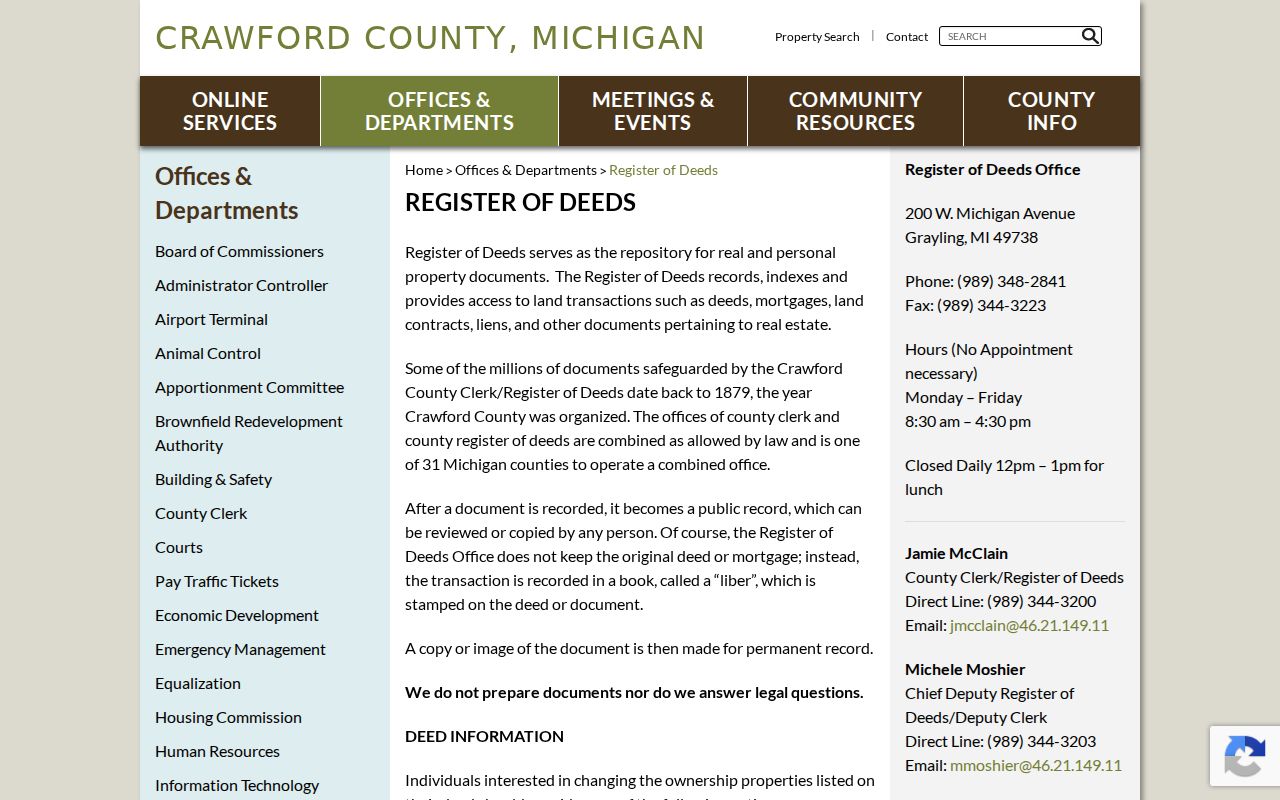
The Register's page routes visitors to the search tools. The index entry and the deed image still have to be opened or requested separately to complete the records search.
Search Keys in Crawford County Deed Records
The county's documented search route relies on party names and legal descriptions. Labels on the online tools may vary. Keep spelling variants in play, along with entity, trust, or estate styles, since one owner of record can appear in the deed index several different ways.
| Search key | Best use | What to preserve |
|---|---|---|
| Grantor or grantee | Follow ownership from one party to the next | Exact indexed name and role |
| Legal description | Find land when an address changed | Lot/block or section calls |
| Instrument number | Retrieve a known record | Number and recording date |
| Liber and page | Locate book-era and cited records | Both parts of the citation |
| Parcel number | Cross-check the tax parcel | Leading zeroes and punctuation |
Note: The earliest year covered by the public online deed index is not stated, so never treat a web search as complete by assumption.
Follow Crawford County's Grantor-Grantee Chain
Start at the newest reliable deed. Do not begin with a surname picked at random. Before stepping back through the chain, compare each conveyance's legal description with the parcel. Write down the instrument reference.
Recording dates and execution dates are not the same thing. Keep them separate in your notes. Consideration and transfer-tax notation deserve a line as well. Also note related instruments, redactions, and the reason each filing belongs in the chain.
A quitclaim, corrective deed, survivorship affidavit, personal-representative deed, or release still matters. It should not vanish just because the ownership sequence would look tidier without it.
Encumbrances create branches that a straight seller-to-buyer list can miss. Search mortgages and land contracts during each ownership period. Then hunt for later assignments, discharges, releases, foreclosures, or continuations. A trustee, personal representative, or heir may have signed the deed. Weigh that party's authority against the related trust or probate material. A mismatch between the current assessed owner and the newest grantee can stem from an update lag. It may also reflect a name abbreviation, a different entity style, estate administration, or a later instrument. State the discrepancy plainly rather than quietly picking one name.
- Find the current assessed owner, then locate that party as grantee on the latest recorded transfer.
- Copy the grantor, grantee, legal description, recording and execution dates, instrument number, and liber/page.
- Search the grantor as an earlier grantee, checking name variants and authority for trusts, entities, or estates.
- Repeat until the online trail stops, then carry the last citation to the counter or archival deed books.
- Grantor
- The party conveying the stated interest.
- Grantee
- The party receiving the stated interest.
- Chain of title
- The ordered sequence of instruments affecting the same land.
- Liber/page and instrument number
- Two forms of retrieval citation; copy whichever the index supplies.
Crawford County Deed Books Reach Beyond the Web
Crawford County's oldest deeds live in archives. The Archives of Michigan documents a Crawford deed index covering 1863 through 1943 and deed books from 1864 through 1943. Mortgage books run 1871 through 1939. A mortgage index covers 1871 through 1900, and a tract book covers 1871 through 1885. These are archival series dates, not a promise of what Tapestry shows.
Crawford's boundaries have shifted over time. Surveyors laid it out as Shawono in 1840. The county took its current name in 1843. Local organization waited until 1879, so land from earlier years may sit in federal patents, tract material, or records kept by another jurisdiction. A statewide plat search adds one more route into subdivision history.
Historic tax rolls support this work. The Archives guide lists Crawford tax rolls from 1876 through 1980, and the Library of Michigan identifies owner-indexed plat book editions from 1930, 1965, and 2009. A surname there is a dated clue. Carry its spelling, year, map reference, and description back to the formal deed index. The Crawford County Library keeps newspaper and local-history collections that can resolve a name or place, but a directory or newspaper mention is not a recorded conveyance.
Grayling's origins show how old these keys run. The railroad platted the original Village of Grayling in 1874. A county brownfield plan cites Block 17 at Liber 1 of Plats, Page 2. A current parcel can therefore carry a recorded key more than a century old.
Watch New Crawford County Filings by Name
Crawford County posts a free Fidlar property-fraud alert service. It sends notice by email or phone when a new instrument records under a name you choose. A match does not mean fraud, though. It may involve a different person, entity, or estate. The enrollment page shows the alert route used for Crawford County deed records:
An unfamiliar alert deserves a careful look. Compare its indexed details with the recorded image and contact the Register before drawing any conclusion.
Crawford County Copy and Recording Charges
Copies cost $1 per page at the Register's office. Certification adds $5 to a document. Recording runs $30 no matter the page count, subject to listed MSSR exceptions. Each assigned or discharged instrument adds $3. Certain warranty conveyances also require a $5 tax certificate.
Transfer taxes are separate. The published county tax is $0.55 per $500 or fraction, and the state tax is $3.75 per $500 or fraction. These figures cover recording mechanics only. They say nothing about full consideration, title quality, or taxes actually owed. A tax certificate confirms one procedural step at recording. It does not replace a delinquent-tax inquiry, a lien search, or a review of the deed's legal description. Confirm exemptions and current charges with the Register before filing or ordering a large copy set. Save the fee-page date, receipt, retrieval citation, and certification status with each copy.
One published price conflicts with another. The current Register page lists Tapestry at $8.95 per name or legal-description search, while an older Clerk page says $6.95. Check the live route or call before paying, since the conflict is a reason to date the source rather than pick the lower number.
Order a Crawford County Deed Copy
Begin with the online index when one exists. Its instrument number or liber/page retrieves the image. The online image may be gated or absent. Then use the public computer at the Register's counter. Callers and mail requesters should give the full retrieval data. Say whether an ordinary or certified copy is needed. Archival requests need the specific Archives of Michigan series and date span. A county administrative file is not a recorded instrument. Use Crawford's FOIA process and name the likely custodian. Close with a dated source note. It should record the exact instrument inspected. Note any unresolved break in the chain of title.
Recorded does not mean guaranteed. Crawford County's index reports filed instruments, not a title opinion. Unrecorded interests, later corrections, or legal disputes may require certified records and professional review.