
Reconstruct Crawford County's Backward Ownership Timeline
Build a transfer worksheet instead of a loose list of names. One row per conveyance keeps the work honest. Record the date, the parties, and the deed type. Add the liber and page for every transfer. That structure ties each former owner to the very same land in Crawford County.
| Historical source | Documented span | Access route | Role in the chain |
|---|---|---|---|
| Deed index | 1863–1943 archival run | Archives guide and Register | Grantor/grantee entry point |
| Deed books | 1864–1943 archival run | Archives of Michigan | Instrument text and legal description |
| Mortgage books/index | Books 1871–1939; index 1871–1900 | Archives guide | Financing names and releases |
| Tax rolls | 1876–1980 | Archives guide | Yearly clue, not a deed |
These archival holdings are documented collections rather than a promise of full online coverage, and the Register publishes no start year for its Tapestry deed index.
Follow Crawford County Liber and Page Breadcrumbs
The Register of Deeds stamps each recorded transaction into a liber. It also keeps a permanent image of it. For every hit, save the grantor, grantee, document type, recording date, instrument number, liber and page, legal description, image status, and the spelling you searched. An index-only entry is not the whole story. Always pull the deed image itself. The Crawford Register page lays out the Tapestry, Laredo, public-computer, phone, and counter routes for getting there.
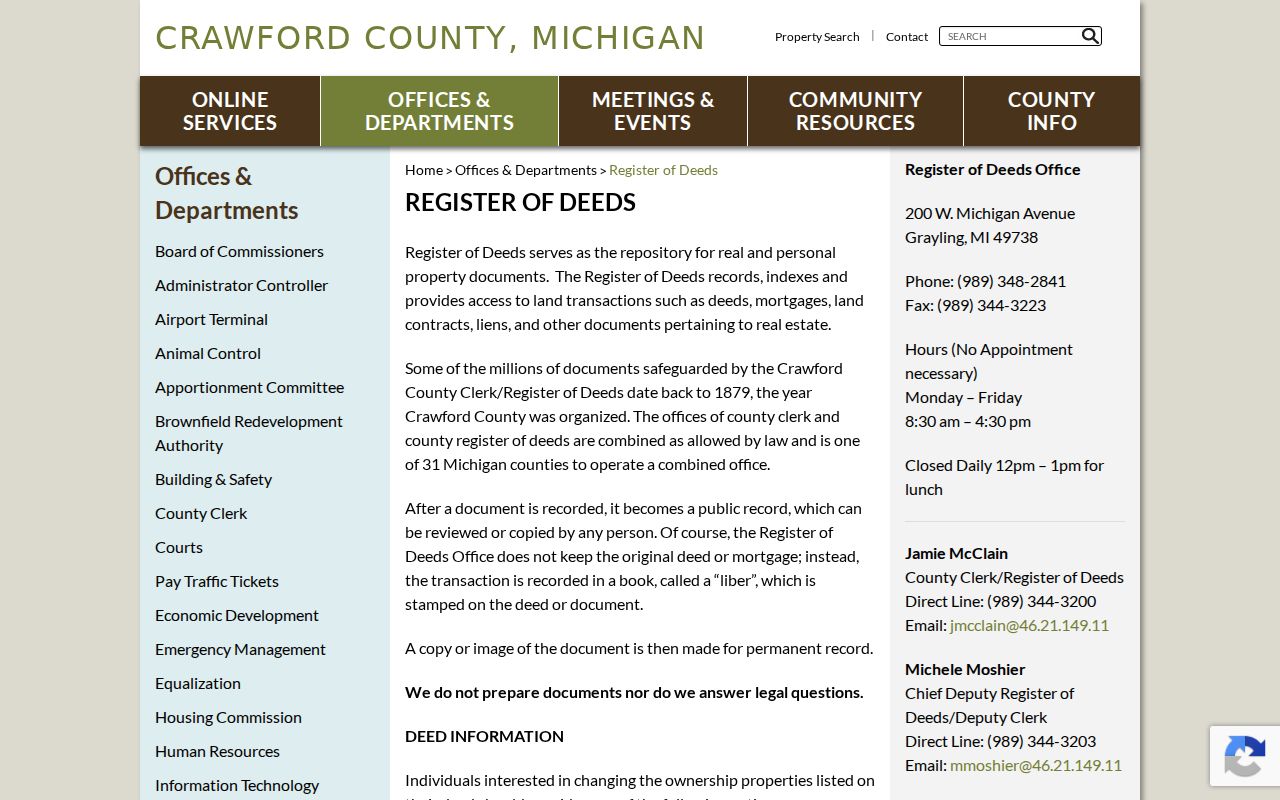
The Register of Deeds is the custodian, and access runs through the channels described above, so confirm each previous owner against the actual deed image.
Walk the Crawford County Deed Chain Backward
Start with the current parcel number and the newest deed. Work backward from there.
A repeated surname in Crawford County deed records does not guarantee the same owner of record. Verify each transfer.
- Find the current acquisition deed and confirm its legal description.
- Read its grantor as the prior owner and save all name variants.
- Search that party as a grantee to locate the earlier acquisition.
- Repeat through Tapestry, then continue in older index and deed-book references.
- Grantor / grantee
- The conveying and receiving parties.
- Chain of title
- The ordered sequence of interests for the same land.
- Reverse index
- An index used to follow a party in the opposite role.
- Quitclaim / warranty deed
- Different conveyance forms read from the instrument itself.
Branch into Crawford Plats and Tract Books
A deed can shift its description mid-chain. One transfer uses a street address. The next uses lot and block, section-township-range, a government lot, or metes and bounds. The Archives guide lists a Crawford County tract book covering 1871 through 1885. Michigan's statewide plat program began in 1873. It now reports more than 66,000 plats with over 99% image availability.
Grayling was platted in 1874 by the Jackson, Lansing & Saginaw Railroad. Modern material cites Block 17 of the Original Plat, Liber 1 of Plats, Page 2. Older deeds may reference Lake, Ingham, Chestnut, or the former Pine street. Those historic names can bridge an old deed to today's plat and GIS map.
Explain Crawford County Chain Breaks with Probate
A former owner's death can break a clean sequence. Probate explains the break. Search Crawford County records for the estate case, the personal representative, the court order, and the later fiduciary deed. Crawford archival probate series begin in the nineteenth century with differing endpoints. Probate establishes authority and context; the recorded conveyance finishes the land-record step.
Newspapers and the Crawford Avalanche archive can clarify estates, aliases, and address changes. Treat them as leads. Then return to the deed index for proof.
Keep Crawford mortgage history beside the owner chain.
Historic mortgage books identify lenders, assignments, and discharges tied to former owners. But a mortgagee is not automatically an owner of record. Log the original parties, every assignment, and the release. Keep that financing sequence separate from the deed transfers in your chain.
Note: Tax rolls and mortgages strengthen identity and timing, but neither replaces a conveyance in a Crawford County previous-owner chain.
Continue Crawford's Chain Through Every Access Channel
Tapestry is the occasional-use, legal-description route, while Laredo serves professional subscribers. The Register also offers public computers. Telephone guidance is available, as are mail or counter requests. Copy and certification services round out the options. Its current page listed an $8.95 search fee, and an older Clerk page listed $6.95. Confirm the live amount before budgeting. Either figure could be stale.
When requesting an older deed, provide the party names, approximate dates, liber and page or instrument number, and legal description. The office sits at 200 W Michigan Avenue in Grayling. Hours run Monday through Friday, 8:30 a.m. to 4:30 p.m., with a closure from noon to 1 p.m. A narrow request is easier to route. It beats a demand for every record under a surname.
Preserve Crawford County Name and Role Variants
Former owners hide behind many disguises. Initials, changed surnames, and spouses' names obscure them. So do trusts, estates, corporate suffixes, and representative capacities. Search each variant separately. Label each role clearly. A grantor conveyed an interest. A grantee received one. An executor or personal representative acted for an estate, so each label marks a different legal position. A mortgage party may never have owned the property at all.
The chain sometimes reaches an entity. Michigan business records can then corroborate its exact legal name and filing identity. A registered office or agent proves nothing about real-property ownership. For an estate, establish authority through probate. Then return to the recorded fiduciary deed. This role discipline keeps a plausible historical name from being promoted into a former owner without an instrument behind it.
Document Crawford's Online and Archival Dates Separately
The deed index range of 1863 through 1943 comes from the Archives guide. Deed books from 1864 to 1943 do too. Those ranges do not reveal where Tapestry begins. They cannot promise that every item survives, is indexed consistently, or has a web image. Report the first and last online results you actually viewed. Then name the physical or archival series used beyond that point.
Crawford County's government was organized in 1879 after earlier administration by other counties. So a nineteenth-century gap may reflect jurisdiction rather than lost ownership. Check the date, the county in charge at the time, the tract-book reference, the patent context, and the original plat. Do this before declaring the chain ended.
Assemble Crawford's Former-Owner Evidence Packet
For every transfer, keep a citation to the deed image, the search name, the recording reference, your access date, and the matched legal description. Add separate notes for plats, probate, mortgages, tax rolls, and newspapers. If a document is indexed but its image went unexamined, label it index only. When the chain changes parcel description, show the instrument that caused the split, combination, dedication, or replat.
This packet makes the history auditable and exposes gaps plainly. It also stops a later researcher from mistaking an archive date range for proof that a particular Crawford County deed was ever examined.
Use Crawford Newspapers as Clues, Then Return to Deeds
Newspapers can unlock a stalled Crawford County deed search. The Crawford Avalanche started in 1879. Library of Michigan holdings also list the Grayling News and the Northern Democrat. An estate notice, a business name, an anniversary piece, or even an alternate spelling of a surname can explain why the deed index keeps failing you. The Crawford County Library's archive and its historical directories are the places to look. Cemetery and vital records help too. They separate neighbors who happened to share a name.
Remember what these sources are, though. A clipping proves context, not title. Note the notice title and its date. Then carry the corrected name, estate identity, or older address back into the deed records, the probate file, the plat, or the tax roll. If no recorded transfer ever surfaces, keep the newspaper item as a lead and say so plainly.
Track Crawford Legal-Description Changes Across Owners
A Crawford County ownership chain often looks broken when it is really just redescribed. Land gets split, combined, replatted, vacated, dedicated, or corrected. Any of those changes can alter the description between one deed and the next. So compare acreage, lot and block, section-township-range, government lot, and metes-and-bounds calls owner by owner. An APN helps with modern retrieval. Older records may predate the parcel number entirely. Watch for a copied legal-description error that travels quietly through every later document.
Follow the paper wherever a deed points. If it cites a plat, open that plat. Search the later instruments tied to it. If it cites an easement or restriction, track that interest beside the ownership sequence. And state clearly whether each former owner held the whole parcel. Note any partial interest or differently described land. A tidy surname timeline can otherwise hide a real break in title.
State the Endpoint of Crawford County Ownership Research
Crawford County has an unusual beginning. It was laid out as Shawono in 1840, renamed in 1843, and run by other counties until local government formed in 1879. For the earliest land, pin down the date and the governing jurisdiction before anything else. A defensible former-owner report names the last verified image. The oldest source consulted and every interval left unresolved should also be named.
Historical scope. Use former-owner records for house history, estate work, boundary research, and purchase diligence. Never use a chain to track, harass, intimidate, or harm a living person.